What if the internet is already dead?
The theory says most of what you see online is bots talking to bots. A few years ago it sounded paranoid. Now it sounds a little too familiar.
The theory says most of what you see online is bots talking to bots. A few years ago it sounded paranoid. Now it sounds a little too familiar.
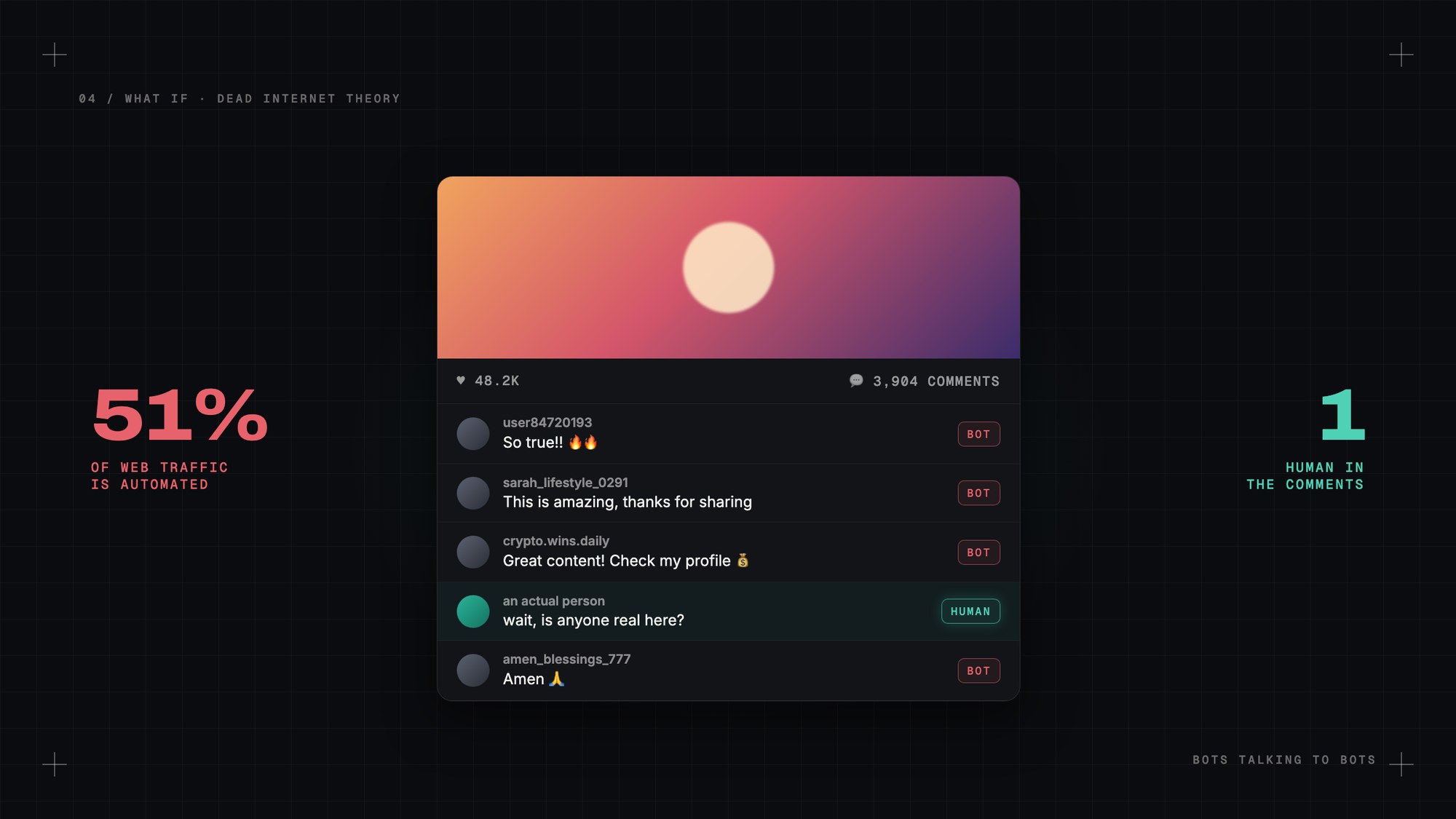
Scroll through the comments under any viral post. "So true!" "This is amazing 🔥" "Who else is watching this at 3 a.m.?" A profile picture that's a little too perfect, a username with eight random numbers at the end, and a bio that says nothing at all.
At some point you start wondering: is anyone actually here?
That feeling has a name. The Dead Internet Theory.
The theory took shape in 2021, in a long post on a small online forum. The author argued that the internet "died" somewhere around 2016 or 2017. Since then, they claimed, most of the content and activity online has been generated by bots and algorithms, with real humans a shrinking minority. The darker version says it's deliberate: governments and corporations filling the internet with fake activity to shape what we think and buy.
The Atlantic wrote about it later that year, under a headline that asked whether the internet had died five years earlier and we'd simply missed it. It was presented as a strange, slightly ridiculous idea. Fun to read about. Obviously not true.
The theory started as paranoia. Then the bots got better at writing.
Then generative AI arrived. And a lot of things the theory predicted started showing up in plain sight.
The bot traffic is real. Imperva, a security company, releases an annual report on website visitors. For years, bots have accounted for nearly half of all web traffic. In their latest reports, automated traffic now outnumbers human traffic.
AI content is everywhere. In 2024, Facebook feeds were full of strange AI-generated images, like "Shrimp Jesus"—a picture of Jesus made of shrimp. Thousands of comments said "Amen". Many of those comments looked automated too. Bots posting for bots, with algorithms encouraging them, because engagement is engagement.
Even the people building it noticed. Sam Altman, CEO of OpenAI, joked online that he never took the dead internet theory seriously. But he added that there seem to be a lot of AI-run accounts around now. When the person behind ChatGPT says that, you pay attention.
Search results feel emptier. Look up a product review and you'll often find pages that read like they were written by nobody, for nobody, mostly to sell you something. That's because many of them were.
Here's where I get off the train.
The internet clearly isn't dead. Real people are still here: arguing in group chats, posting holiday photos, writing long angry reviews, building websites like this one. I still get comments from people I can actually talk back to. Bots are many, but they're mostly noise. They don't replace us.
The "secret plan" idea doesn't hold up. There's no proof of a single coordinated conspiracy. What there is, is something more boring and in some ways worse: lots of separate actors—spammers, scammers, marketers, propaganda farms, and platforms hungry for engagement—all with a motive to create fake activity. No one needs to plan it. The money does the planning.
I've started treating the internet a bit like a busy city. Most of the noise isn't meant for me. I look for signs of a real person: someone who has a history, a face, a point of view, who replies like a human, makes typos, disagrees sometimes.
I follow people, not feeds. I pay more attention to small communities where everyone knows everyone. And I've accepted that the "comment section" is, more and more, a performance by machines for an algorithm.
The funny thing is, that makes real human corners of the internet feel more valuable. Like this one, I hope.
Verdict: not dead, but crowded with bots. The internet's still alive, just harder to hear over the machines.
— Desly