What if my phone is slowing down on purpose?
Every phone gets slower after a new model comes out. Coincidence, or a plan to make you upgrade? The answer is more interesting, and partly true.
Every phone gets slower after a new model comes out. Coincidence, or a plan to make you upgrade? The answer is more interesting, and partly true.
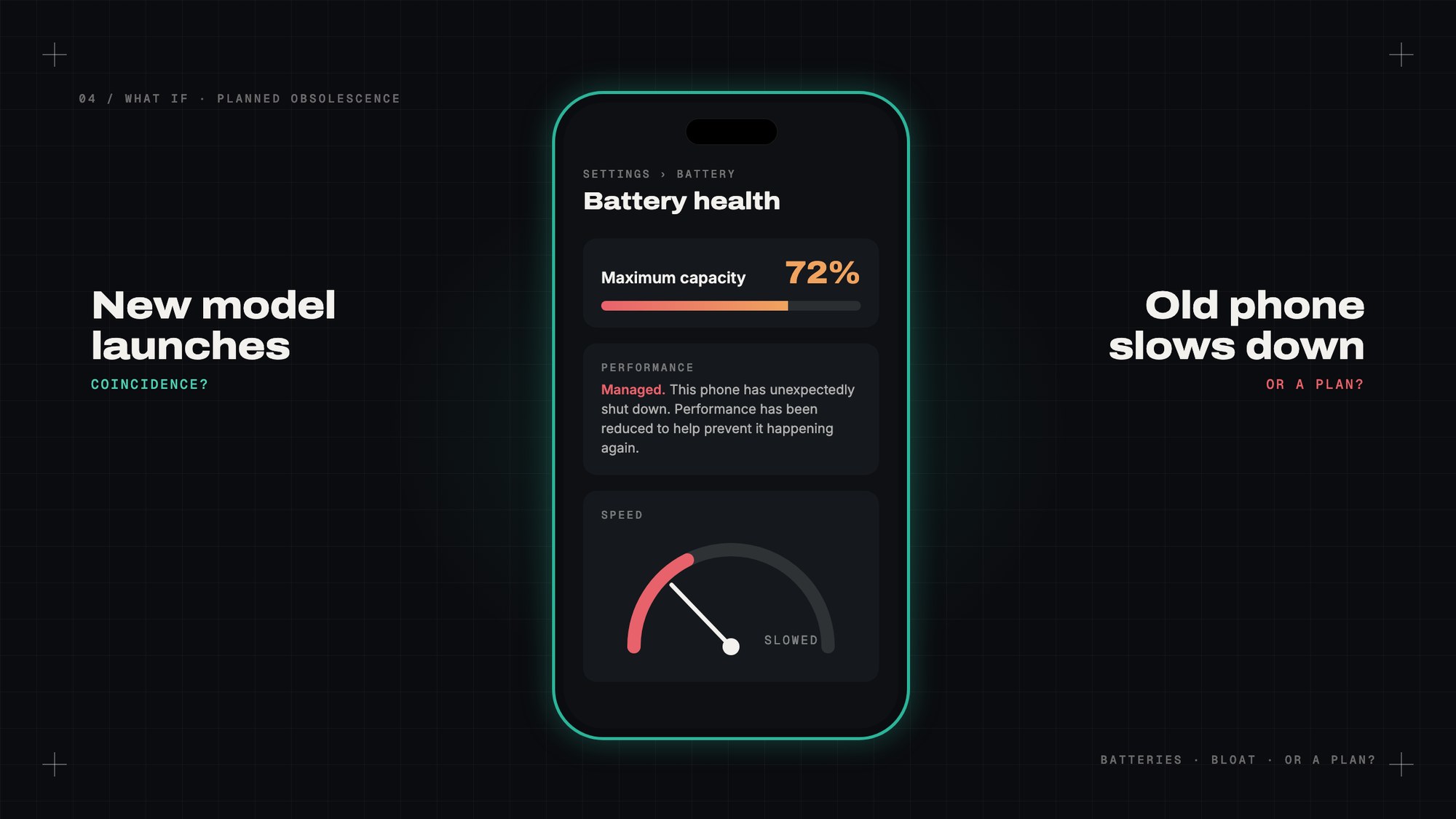
You know the feeling. Your phone was fast. Then, around the time the shiny new model launches, apps start taking a second longer to open. The keyboard lags. The battery gives up before dinner. And a small voice says: they're doing this on purpose.
The theory is called planned obsolescence, the idea that companies design products to fail or slow down so you'll buy new ones. This one has some real history behind it, unlike most theories in this section.
In the 1920s, the world's biggest light bulb makers formed a group known as the Phoebus cartel. They agreed to limit bulb life to about 1,000 hours, and fined members whose bulbs lasted too long. It's one of the clearest documented cases of a whole industry making products worse on purpose.
So the idea isn't crazy. The question is whether it's happening in your pocket.
In 2017, users noticed that some older iPhones got dramatically faster after a battery replacement. A developer at Geekbench, a popular performance-testing app, looked at the data and found a clear pattern: iPhones with worn batteries were running slower.
Apple confirmed it. An iOS update had added a feature that slowed down iPhones with ageing batteries. Apple's explanation was that old batteries can't always deliver enough power at peak demand, which was causing some phones to shut down unexpectedly. Slowing the processor prevented the shutdowns.
The slowdown was real. Not telling anyone was the real mistake.
That explanation is technically reasonable. The problem was that Apple didn't tell anyone. People thought their phones were simply getting old and bought new ones, when a cheaper battery would have fixed it.
The fallout was huge. Apple apologised and cut the price of battery replacements. It added a Battery Health screen to iOS so you can see your battery's condition and whether the phone is being slowed down. It paid hundreds of millions of dollars to settle lawsuits in the US, and France fined it 25 million euros. In Italy, regulators fined both Apple and Samsung over software updates that hurt older phones' performance.
Probably not in the way the theory says. There's no good evidence that phones secretly get a "slow down now" signal when a new model launches. But several real things make phones feel slower over time, and they tend to happen together:
The batterygate scandal helped push governments to act. In the EU, new rules now require phones to have batteries that keep most of their capacity for hundreds of charge cycles, make spare parts available for years, and keep getting software updates for years after a model stops being sold. Right-to-repair is slowly becoming the law, not just a slogan.
When a phone starts feeling slow, before I think about upgrading, I check the battery health first. If it's worn, a new battery is far cheaper than a new phone and often feels like getting a new phone. Then I clear out storage and delete apps I don't use. Most of the time, that's enough to buy another year or two.
And when I do upgrade, I try to make it because the new phone does something I actually want, not because the old one has been made to feel tired.
Verdict: partly true. It has happened, it got caught, and it got fined. But most slowdowns are batteries, bloat and time, not a secret plan.
— Desly