Cutting the cloud bill by a third
The quick wins and long-term habits that make a cloud bill smaller.
The quick wins and long-term habits that make a cloud bill smaller.
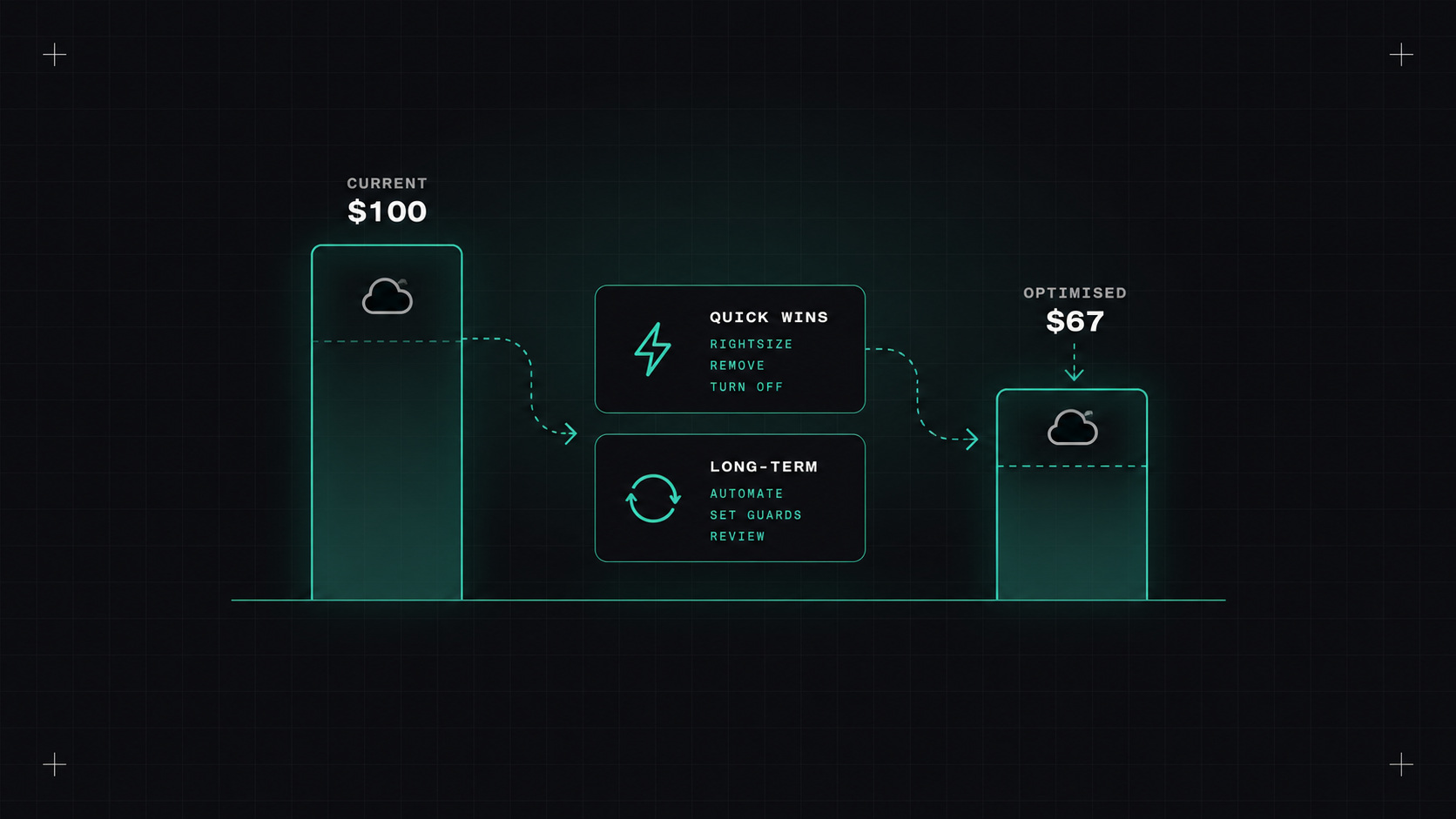
Cloud bills have a way of growing quietly. A test environment nobody deleted. A database sized for a launch that never needed it. Snapshots from 2022. Data transfer charges nobody understands. Each one is small. Together, they add up to a bill that makes finance ask uncomfortable questions.
Industry surveys often say that a big chunk of cloud spending—usually a quarter to a third—is wasted. From my experience, cutting a typical bill by 20 to 30% is realistic without hurting performance. Here's how.
FinOps is the practice of bringing financial accountability to cloud spending. The FinOps Foundation describes a simple cycle:
The most important idea: cost isn't just finance's problem. Engineers make the decisions that create costs, every time they choose an instance size or a storage class. So engineers need to see the numbers.
Before making cuts, look at the data. Every cloud provider has cost tools (AWS Cost Explorer, Azure Cost Management, Google Cloud Billing reports). Group costs by service, account or project, and tags.
Usually, a few categories dominate:
And make sure resources are tagged with owner, team, environment and service. Without tags, you can't tell who owns what, and nobody feels responsible.
A cloud bill nobody looks at is a cloud bill that only grows.
These usually take days, not months:
Once usage is right-sized, get better prices for what remains:
Savings Plans and Reserved Instances (AWS), reservations and savings plans (Azure), committed use discounts (Google Cloud): commit to a certain level of usage for one or three years, and get significant discounts. Best for stable, predictable baseline usage. Commit to your baseline, not your peak.
Spot instances (AWS), Spot VMs (Azure, Google Cloud): spare capacity at large discounts, but they can be taken away with short notice. Great for:
Not for: single-instance databases or anything that can't handle interruption.
Some costs hide well:
Quick wins fade if nothing changes in how people work:
Tag everything, find your top ten most expensive resources, and check each one: is it needed, is it the right size, is it running when it doesn't have to? That exercise alone usually finds the first 10 to 20% of savings. Then commitments and Spot take you further.
My take: the cloud lets you spend money at the speed of an API call. Make sure someone is watching at the same speed.
— Desly