What if the Titanic never sank?
The theory says the ship at the bottom of the Atlantic is actually her damaged twin, sunk on purpose for the insurance money. It's a clever story. The wreck tells a different one.
The theory says the ship at the bottom of the Atlantic is actually her damaged twin, sunk on purpose for the insurance money. It's a clever story. The wreck tells a different one.
Everyone knows the story of the Titanic. The "unsinkable" ship, the iceberg, the band playing on, not enough lifeboats, more than 1,500 people lost on a freezing April night in 1912.
There's a theory that the ship that sank wasn't the Titanic at all. It was her nearly identical older sister, the Olympic, swapped in secret and sunk on purpose so the owners could collect insurance money.
It's one of those theories that sounds ridiculous at first and then, for about ten minutes, surprisingly convincing. So let's give it those ten minutes.
The White Star Line built three giant sister ships in Belfast: Olympic, Titanic and later Britannic. Olympic was finished first, in 1911. Titanic followed a year later. From the outside, they looked almost exactly the same: the same black hull, the same four tall funnels, the same lines.
In September 1911, Olympic collided with a British warship, HMS Hawke. Olympic was badly damaged, and an inquiry decided Olympic was to blame. That meant, the theory says, the insurance wouldn't pay for the repairs. Repairs were expensive, and they delayed work on Titanic.
The idea was popularised in a 1998 book by Robin Gardiner. It goes like this: White Star secretly swapped the two ships. The damaged Olympic was dressed up as Titanic, sent out on the maiden voyage, and deliberately sunk to collect the insurance on a "brand-new" ship. Rescue ships were supposedly waiting nearby, but something went wrong. The real Titanic, meanwhile, sailed on for years under the name Olympic.
There's an even darker version. J.P. Morgan, the banker whose company owned White Star, cancelled his trip at the last minute. Some of the richest men in the world died on board. So, the theory goes, maybe the sinking was planned to get rid of them. That version has even less behind it.
For the switch to work, thousands of shipyard workers would have had to keep a perfect secret, forever.
The money doesn't work. Titanic was insured for about £1 million, but she cost about £1.5 million to build. Sinking her on purpose would have meant losing a huge amount of money, not making it. And White Star lost its reputation, faced lawsuits and paid out claims for years.
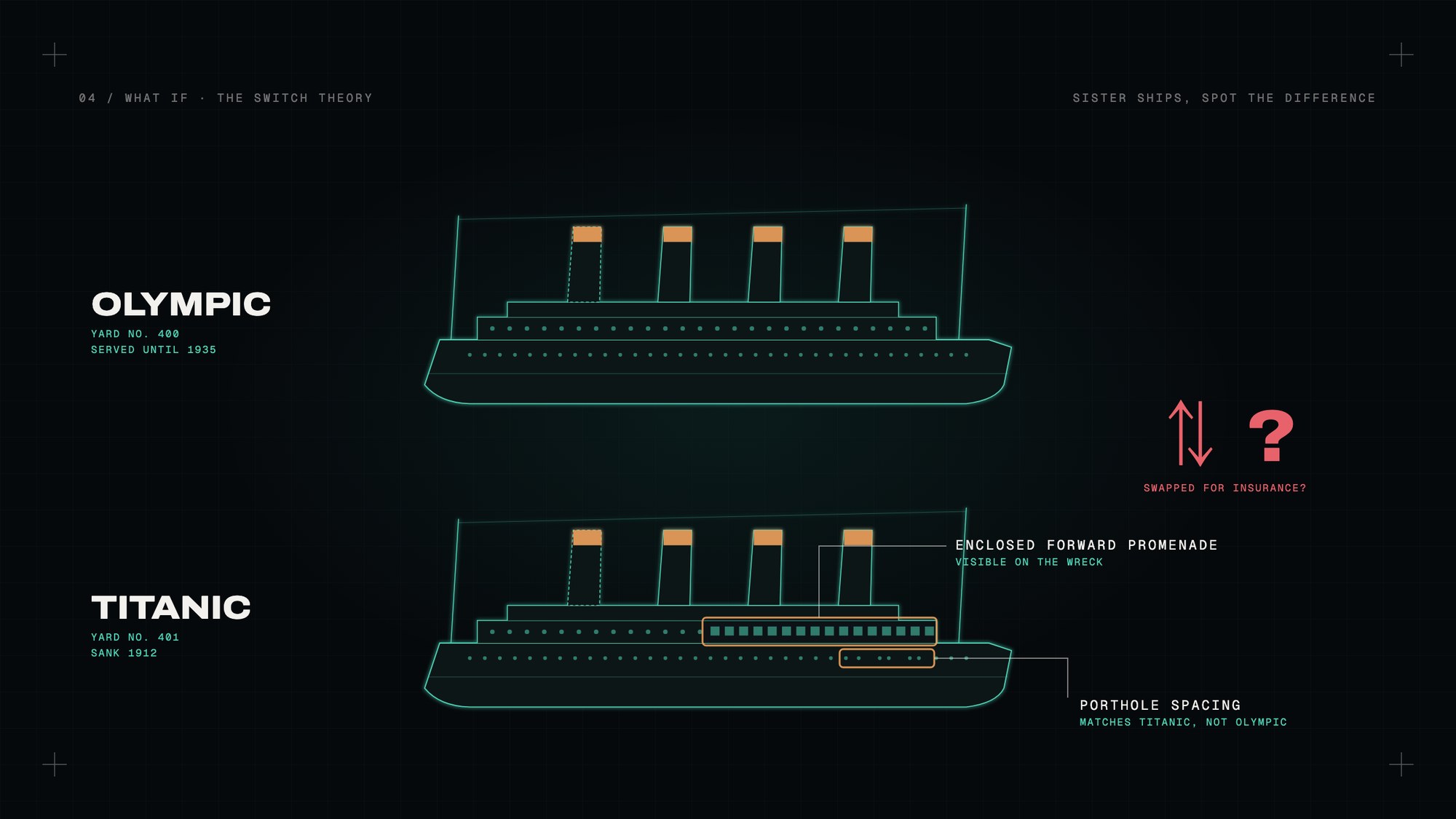
The sisters weren't identical. When Titanic was built, the designers made changes based on Olympic's first months at sea. The most visible one: the forward half of Titanic's A-deck promenade was enclosed with windows, to protect passengers from spray. On Olympic, it was open. The number and spacing of some portholes near the bow were also different. Photos of the wreck show Titanic's layout, not Olympic's.
The number on the propeller. In the shipyard, Olympic was hull number 400 and Titanic was 401. Explorers of the wreck have reported the number 401 stamped on one of the propeller blades.
The wreck has been scanned in detail. In 2023, a team made a full digital 3D scan of the wreck, from hundreds of thousands of images. It's the most detailed record we have of the ship, and it's Titanic.
Thousands of people would have known. Swapping two of the biggest moving objects on Earth would have needed thousands of shipyard workers, crew and officials to keep quiet for the rest of their lives. Not one credible person ever confessed.
Olympic went on to have a long and successful career. She carried troops in World War I, was nicknamed "Old Reliable", and stayed in service until 1935, when she was retired and scrapped. Some of her fittings ended up in a hotel in England, where you can still see them today.
I think the Titanic switch theory survives because the real story is so hard to accept. A ship called unsinkable sank on her first voyage, because of speed, overconfidence, an iceberg and not enough lifeboats. That's not a plot. It's just a terrible series of human decisions.
A secret swap gives the tragedy a villain and a reason. And people prefer stories with reasons. But sometimes the real lesson is simpler and harder: no ship is unsinkable, and no amount of confidence replaces a lifeboat.
Verdict: no switch. The ship at the bottom of the Atlantic is Titanic, hull number 401. The tragedy was real, and that's sad enough.
— Desly