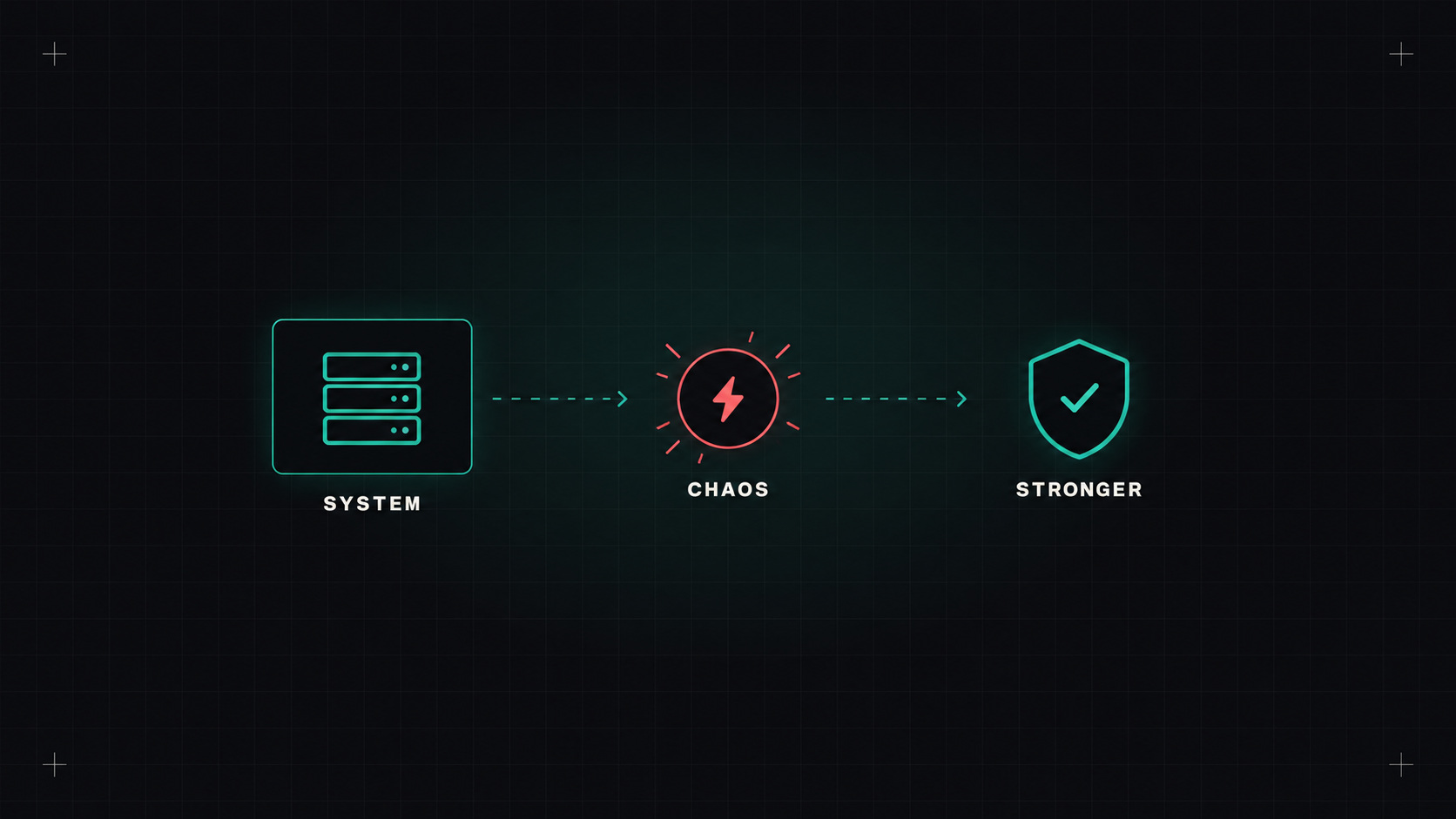
Every system has weaknesses nobody knows about. A timeout that's too long. A retry that turns a small problem into a big one. A failover that worked once in testing two years ago and never since. Usually, you discover them during a real outage, at the worst possible time.
Chaos engineering is about finding weaknesses on purpose, in a controlled way, before they cause problems.
The idea
Netflix made chaos engineering famous with Chaos Monkey, a tool that randomly terminated production servers. The idea sounded crazy, but the logic was simple: if servers will fail anyway, make sure your system handles it, by making failure a normal, everyday event.
Today the practice is more careful and scientific than random destruction:
- Define steady state: what does "working normally" look like? Usually measured with metrics like error rate, latency or orders per minute.
- Form a hypothesis: "If one database replica fails, error rates stay below 0.5% and the app recovers within 30 seconds."
- Introduce a failure: kill the replica.
- Observe: did the steady state hold?
- Learn and fix: if not, you've found a weakness before it caused a real outage.
Chaos engineering isn't about breaking things. It's about proving that your system can take a hit, and finding out where it can't.
What kinds of failures?
Common experiments:
- Kill pods or nodes: does Kubernetes reschedule correctly? Do clients reconnect?
- Add network latency: what happens when a dependency becomes slow, not down? (Often worse than being down.)
- Drop network traffic between services, or to an external API.
- Fill disks or exhaust memory and CPU.
- Fail a whole availability zone: does traffic shift?
- Break DNS or certificates.
- Make a dependency return errors.
Your first game day
A game day is a planned session where a team runs chaos experiments together. It's the best way to start.
How I'd run one:
- Pick a non-production environment that's close to production, like staging.
- Choose one service and one or two experiments. For example: kill one pod of the checkout service, then add 500 ms latency to its database calls.
- Write down the hypothesis for each experiment before starting.
- Get everyone in a room or call: the service owners, someone watching dashboards, someone running the experiment.
- Run the experiment, watch the metrics, take notes.
- Have a stop button: know how to end the experiment immediately.
- Debrief: what did we expect, what happened, what will we fix?
The first game day often shows something unexpected: a missing alert, a dashboard that's confusing, an outdated runbook, or a retry storm. That alone makes it worth doing.
Tools to try
- Chaos Mesh (CNCF): a Kubernetes-native tool with a nice UI. Experiments are Kubernetes resources: pod kill, network delay, stress, I/O faults, time skew and more.
- LitmusChaos (CNCF): Kubernetes chaos with a large hub of ready-made experiments and workflows.
- AWS Fault Injection Service and Azure Chaos Studio: managed services for injecting failures into cloud resources, including AZ-level disruptions.
- Gremlin: a commercial platform with safety controls and a good UI.
- Toxiproxy: a simple proxy for simulating network conditions in tests.
A Chaos Mesh experiment adding latency:
apiVersion: chaos-mesh.org/v1alpha1
kind: NetworkChaos
metadata:
  name: checkout-db-latency
  namespace: shop
spec:
  action: delay
  mode: all
  selector:
    namespaces: ["shop"]
    labelSelectors:
      app: checkout
  delay:
    latency: "500ms"
    jitter: "100ms"
  direction: to
  target:
    mode: all
    selector:
      labelSelectors:
        app: orders-db
  duration: "5m"
Starting small, staying safe
- Start in staging, with small blast radius: one pod, one service.
- Make experiments reversible and time-limited.
- Monitor closely and abort if things go further than expected.
- Tell people before you run experiments, especially at first.
- Move to production carefully, only once you trust your monitoring and rollback, and start with the least risky experiments during working hours.
Did it help?
Measure the effect over time:
- Number of weaknesses found and fixed.
- Incidents caused by failure modes you'd already tested (should go down).
- Recovery time in real incidents.
- Team confidence during incidents, which is hard to measure but very real.
So, should you try it?
Yes, even on a small scale. One game day on staging, with one simple experiment, teaches a team more about their system than months of reading architecture diagrams.
My take: every system has a breaking point. Better to find it on a calm Tuesday afternoon than on a busy Saturday night.
— Desly