Will AI take my DevOps job?
An honest view from inside: what AI can already do in my world of pipelines, servers and late-night alerts, what it can't, and how the job is changing.
An honest view from inside: what AI can already do in my world of pipelines, servers and late-night alerts, what it can't, and how the job is changing.
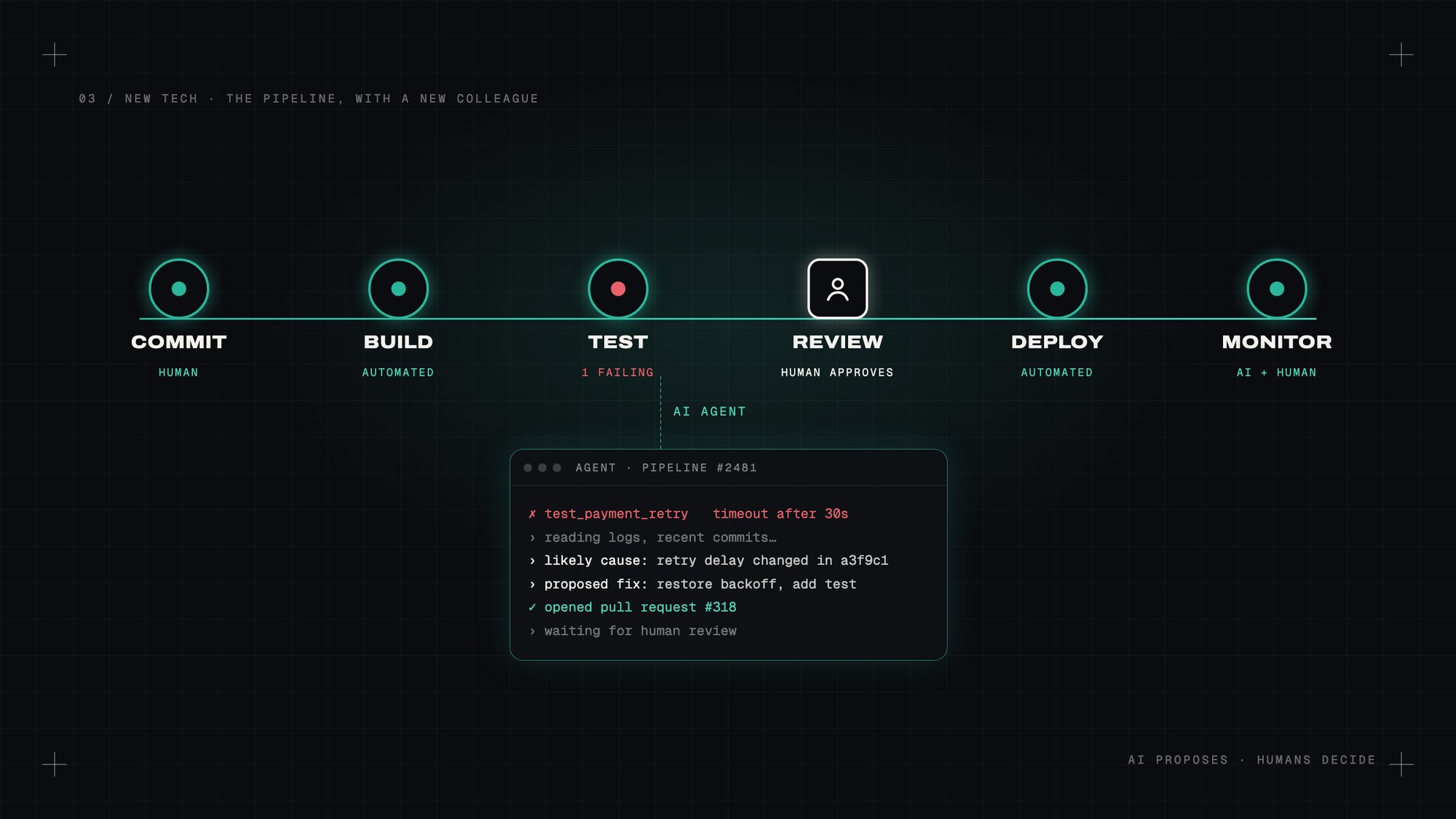
Every few weeks someone sends me a video with a title like "AI agent replaces entire DevOps team." I watch it, I laugh a little, and then, if I'm honest, I think about it a bit longer than I'd like to admit.
I'm a DevOps engineer. My job is to make sure software gets built, tested, shipped and kept running. Pipelines, cloud infrastructure, containers, monitoring, and the occasional alert that ruins a quiet evening. So when people say AI will automate everything, my job is supposed to be near the top of the list. Here's what I actually think.
Let's be fair first. AI has become genuinely useful in DevOps, and pretending otherwise would be silly.
Writing the boring configuration. A pipeline file, a Dockerfile, a Kubernetes manifest, a chunk of Terraform. Things that follow patterns and that I used to copy from old projects or documentation. An AI assistant gets me a solid first draft in seconds.
Reading logs faster than any human. When something breaks, the answer is usually buried in thousands of lines of logs. AI tools are very good at summarising them, spotting the one error that matters and pointing at the change that probably caused it.
Explaining unfamiliar things. An old script nobody remembers writing, a tool I haven't used before, a strange error message. Asking an AI to explain it saves a lot of searching.
Doing small fixes on its own. The newest tools act more like agents. They can see a failing test, read the logs, guess the cause, write a fix and open a pull request. The picture above isn't science fiction anymore.
And yet, the hard parts of my job are mostly not typing.
Knowing the context. Why is this service configured in this strange way? Because three years ago it caused an outage, and the fix was this exact strange setting. That knowledge lives in people's heads, old tickets and half-remembered conversations. AI sees the code. It doesn't see the history.
Taking responsibility. When production is down and customers are affected, someone has to decide: roll back, or push a fix forward? Wake up the database team, or wait ten minutes? Those calls involve risk, trade-offs and accountability. An AI can suggest. A human has to own it.
Being confidently wrong, safely. AI writes configuration that looks perfect and is subtly broken. A permission that's far too open. A setting that works in testing and falls over under real traffic. In infrastructure, small mistakes can be very expensive, or very public. Every AI suggestion still needs someone who can tell the difference.
Talking to people. A surprising amount of DevOps is conversation: understanding what developers need, agreeing on standards, explaining to a manager why we can't just "turn on the cloud and save money". No model does that for me.
AI is a very fast junior engineer who never gets tired, and never quite knows when it's wrong.
I don't think the job is disappearing. I think it's moving up a level.
Less time writing configuration by hand, more time reviewing it. Less time digging through logs, more time deciding what to do about what the logs say. Less time on repetitive fixes, more time designing systems that don't break in the first place. And a new kind of work: setting up the guardrails that let AI agents help safely. What they're allowed to touch, what needs a human approval, how we test their changes, how we undo them.
That last part is very DevOps. We've always been the people who build the safety rails for automation. AI is just a new, very powerful kind of automation.
There's also a funny twist. Someone has to build, deploy and keep the AI systems themselves running. Models need pipelines, monitoring, versioning, rollbacks and on-call too. That's a big part of why I started learning MLOps. If AI is coming into my world, I'd rather understand how it works from the inside than watch it from the outside.
Learn the fundamentals properly, because they're what let you judge AI's output: networking, Linux, how the cloud actually works, security basics. Use AI tools every day and get good at them, the same way earlier generations learned scripting. And practise the human side: writing clearly, explaining trade-offs, staying calm when things break.
The engineers who struggle won't be the ones replaced by AI. They'll be the ones replaced by engineers who use AI well.
Parts of it, yes. The repetitive parts, the copy-and-paste parts, the "read ten thousand log lines" parts. Honestly, I won't miss them.
The job itself? I think it will look quite different in five years. But someone will still need to understand the whole system, make the hard calls, and be the one who says "no, don't deploy that." For now, that's still me.
My take: AI proposes, humans decide. My job is making sure it stays that way where it matters.
— Desly