What if aliens built the pyramids?
Millions of stone blocks, perfect angles, and no cranes. Ancient astronauts make a great TV show. The real story is better.
Millions of stone blocks, perfect angles, and no cranes. Ancient astronauts make a great TV show. The real story is better.
When I visited the little church of St. Bartholomä at Königssee, under the Alps, I remember standing there wondering how people got all that stone to a lake shore you can really only reach by boat. Hundreds of years ago. No trucks, no cranes, no power tools.
Now imagine that feeling multiplied by a few thousand, and you get the Great Pyramid of Giza.
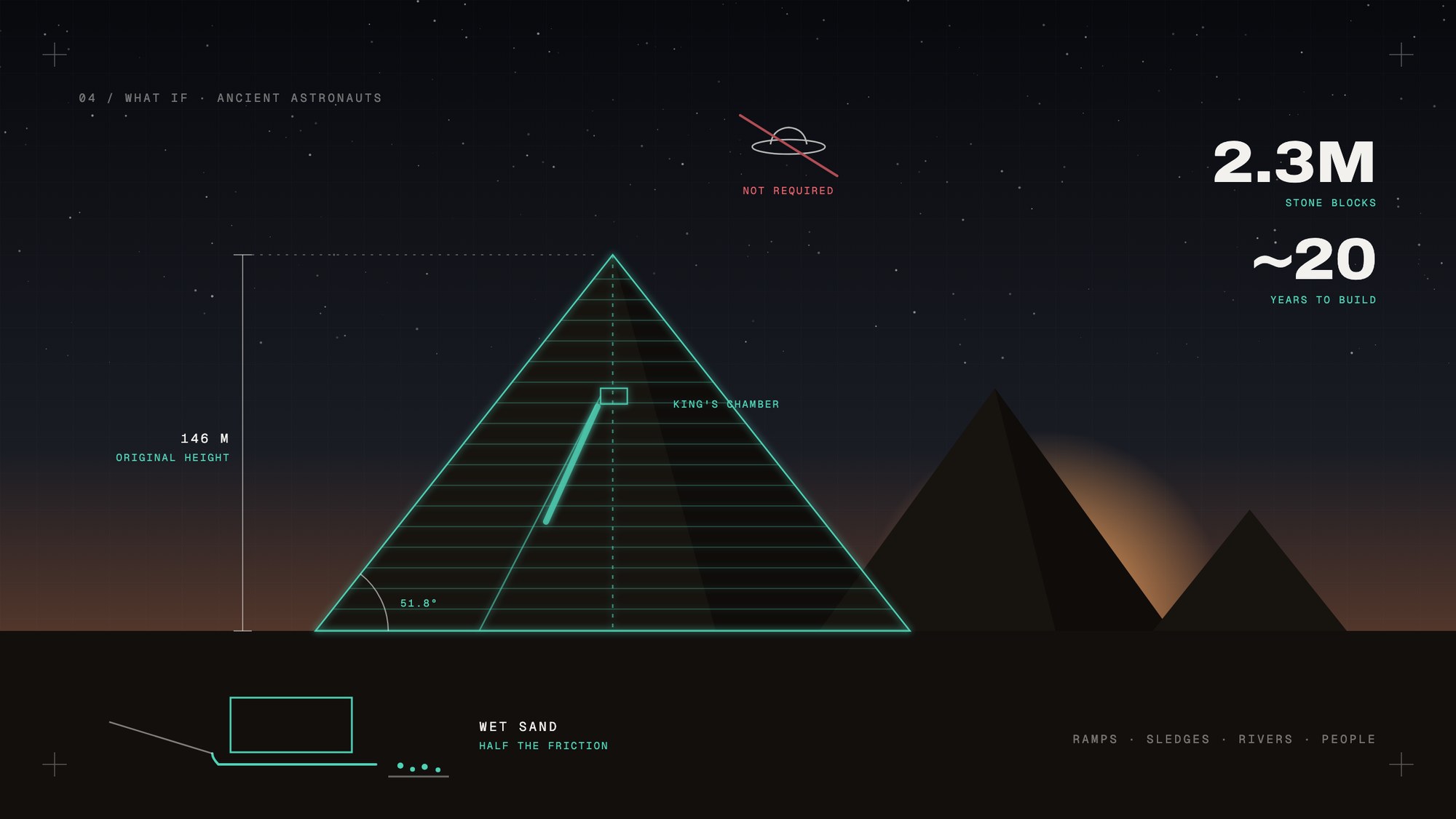
It was built around 4,500 years ago for the pharaoh Khufu. It's made of roughly 2.3 million stone blocks, some weighing many tonnes. It was originally about 146 metres tall, and for nearly four thousand years it was the tallest building humans had ever made. It's aligned to the compass points with astonishing accuracy.
So it's not surprising that some people look at it and think: humans couldn't have done that.
The "ancient astronauts" theory became famous in 1968 with a book by Erich von Däniken called Chariots of the Gods?. He argued that many ancient wonders, from the pyramids to Stonehenge to the Nazca lines in Peru, were built with help from visitors from space, who early humans then remembered as gods.
The book sold millions of copies. Decades later, a TV series called Ancient Aliens turned the idea into a long-running show, complete with dramatic music, and gave the internet a famous meme: "I'm not saying it was aliens... but it was aliens."
The question isn't whether humans could build the pyramids. It's why we find it so hard to believe they did.
Here's what I find fascinating. We don't just have the pyramids. We have a surprising amount of evidence about the people who built them.
The workers' town. Near the pyramids, archaeologists found the remains of a town where the builders lived: bakeries, breweries, sleeping quarters, and enough animal bones to show the workers were well fed with meat. Not slaves in chains, as old movies showed, but organised crews of labourers, many of them likely farmers working in rotation.
The workers' tombs. Right next to the pyramids are the graves of the builders themselves, buried with honour near their king. Some skeletons show healed injuries and signs of medical care.
Their graffiti. Inside the pyramids, in places nobody was supposed to see, work gangs painted their team names. Names like "Friends of Khufu". It's ancient office banter.
A logbook. In 2013, archaeologists found the oldest known inscribed papyri, at a harbour on the Red Sea coast. Among them was the diary of an official called Merer, who describes his team transporting limestone blocks by boat along the Nile to Giza, for the Great Pyramid. It's literally a work diary from the construction project.
The Egyptians moved huge blocks on wooden sledges. An ancient tomb painting shows a giant statue being dragged on a sledge while a man pours water onto the sand in front of it. In 2014, physicists tested this and found that wetting the sand to the right amount roughly halves the friction. It's a simple, clever trick, and it works.
And they had the Nile. A study in 2024 found evidence of an ancient, now-dried branch of the river that once flowed close to the pyramid sites. Boats could bring stone almost to the building site.
Ramps, levers, sledges, boats, an enormous, well-organised workforce, and about twenty years. No spaceships needed.
This is my favourite part. The Egyptians didn't get pyramids right the first time.
The earliest one, the Step Pyramid of Djoser, is basically a stack of flat platforms. A later attempt at Meidum seems to have partially collapsed. Then came the Bent Pyramid, which changes angle halfway up, almost certainly because the builders realised the original slope was too steep and unstable. Only after that did they build the Red Pyramid, and then the Great Pyramid.
That's not what you'd expect from aliens with advanced technology. That's what you'd expect from humans learning by trial and error, over generations. It's engineering. It's beautiful.
It's worth noticing which ancient wonders get credited to aliens. It's usually the pyramids of Egypt, the cities of the Americas, the monuments of Africa and Asia. Rarely anything built in Europe.
Many Egyptians find the alien theory insulting, and I understand why. It quietly takes away one of humanity's greatest achievements from the people who actually did the work.
Coming from Kerala, a place with its own ancient temples, palaces and traditions of craftsmanship, I'd rather celebrate what people built with their own hands and brains. That, to me, is far more impressive than little green men with a crane.
Verdict: built by humans. Thousands of skilled, well-fed, organised humans, who left their names on the walls. No aliens needed.
— Desly