Three Billboards Outside Ebbing, Missouri — anger with nowhere to go
Grief turns into a public confrontation. Frances McDormand anchors a sharp, uncomfortable drama that makes room for humour without easing the hurt.
Grief turns into a public confrontation. Frances McDormand anchors a sharp, uncomfortable drama that makes room for humour without easing the hurt.
Spoiler-light review. Discusses grief and violence without revealing the ending.
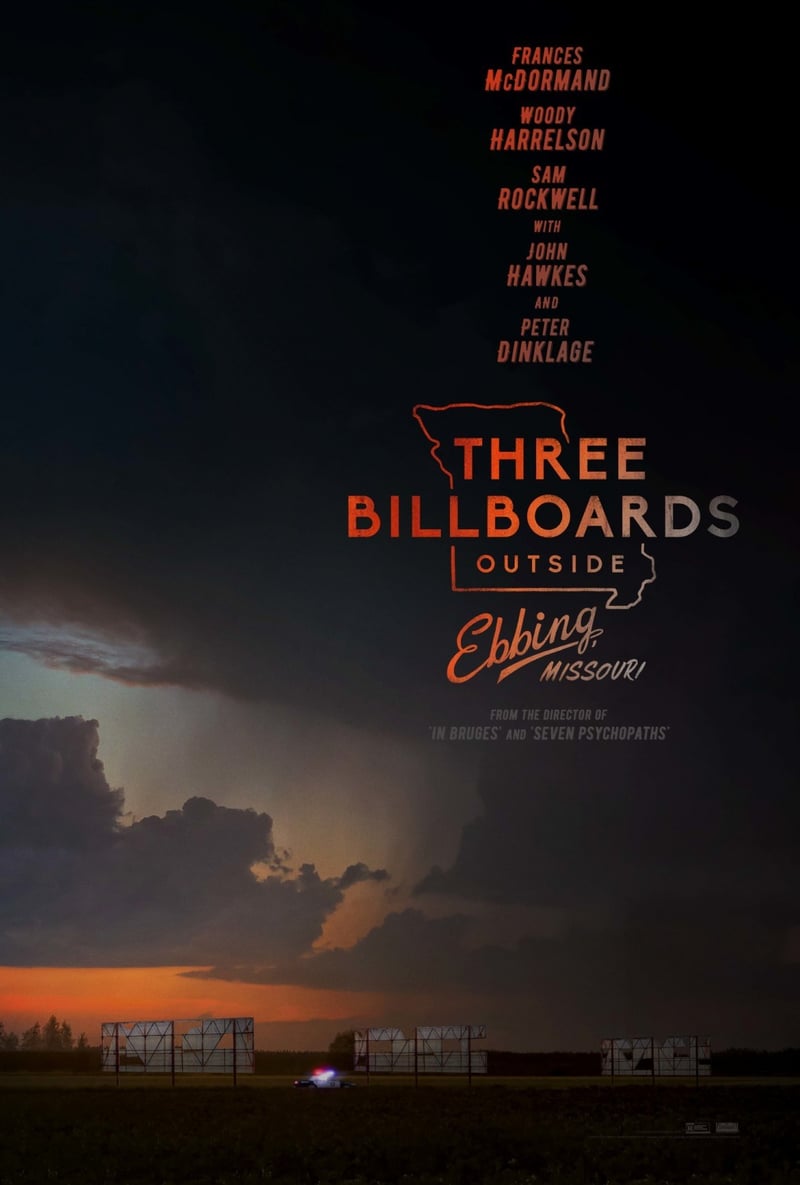
Three signs beside a road become a way of forcing an entire town to look at something it would rather leave alone. Mildred Hayes wants movement in her daughter's unsolved murder case. The billboards are direct, confrontational, and impossible to mistake for a polite request.
That is the starting point of Three Billboards Outside Ebbing, Missouri. What follows is less interested in laying out clues than in what grief does when it has nowhere useful to go.
McDormand gives Mildred an anger that feels like effort. It takes work to keep fighting everyone, and the performance allows the exhaustion to show without making her suddenly gentle. She can be funny, cruel, and painfully vulnerable without seeming like a different person between scenes.
The character does not need to be pleasant to command attention. Her refusal to let the town settle into its routines gives the film its force. At the same time, her certainty does not make every decision wise or every target fair.
Martin McDonagh's dialogue is often funny, even when it's not the right time to laugh. The jokes come from stubbornness, irritation, and people saying things that make bad situations worse.
It does not remove the grief. If anything, the contrast makes the hurt more visible. A scene can turn sharply because the film lets hostility, affection, and absurdity occupy the same space.
Woody Harrelson and Sam Rockwell give the confrontation different kinds of resistance. The town never becomes a simple arrangement of one person who is right and everyone else who is wrong. That complication keeps the drama moving beyond the original provocation.
The film raises questions about how it handles cruelty, racism, and the chance for change. Feeling someone's pain doesn't undo the harm they do. Some shifts in who you sympathise with might feel earned, others might feel too kind. The film is strongest when it leaves that discomfort in place.
The performances give the sharp writing emotional weight. There are moments that could become speeches or symbols, yet the faces and silences keep pulling them back towards people trying to live with something unbearable.
The tonal changes will not work for everyone, and it is worth knowing that the subject matter is distressing. This is not a light comedy with a dramatic premise attached.
A 9/10 rating shows how strong the acting is and how the film makes space for difficult emotions. There's a lot to argue about, which is part of why the drama stays with you after you've seen it.
Written and directed by Martin McDonagh. Dark comedy / drama · English. Film details and official poster: Searchlight Pictures. Artwork © Searchlight Pictures.
Grief turns into a public confrontation. Frances McDormand anchors a sharp, uncomfortable drama that makes room for humour without easing the hurt.
— Desly