SLOs: deciding how reliable is reliable enough
100% uptime is the wrong goal. How error budgets help teams decide.
100% uptime is the wrong goal. How error budgets help teams decide.
Ask any manager how reliable a service should be, and the answer is usually "100%". It sounds right. Who wants downtime?
But 100% is impossible, and chasing it is incredibly expensive. Every extra "nine" of availability costs more than the last. And your users can't tell the difference between 99.99% and 100%, because their own Wi-Fi, phone and ISP fail far more often than that.
Service Level Objectives (SLOs) are a way to decide, on purpose, how reliable is reliable enough.
SLI (Service Level Indicator): a measurement of how your service is doing, from the user's point of view. For example: the percentage of HTTP requests that succeed, or the percentage served in under 300 ms.
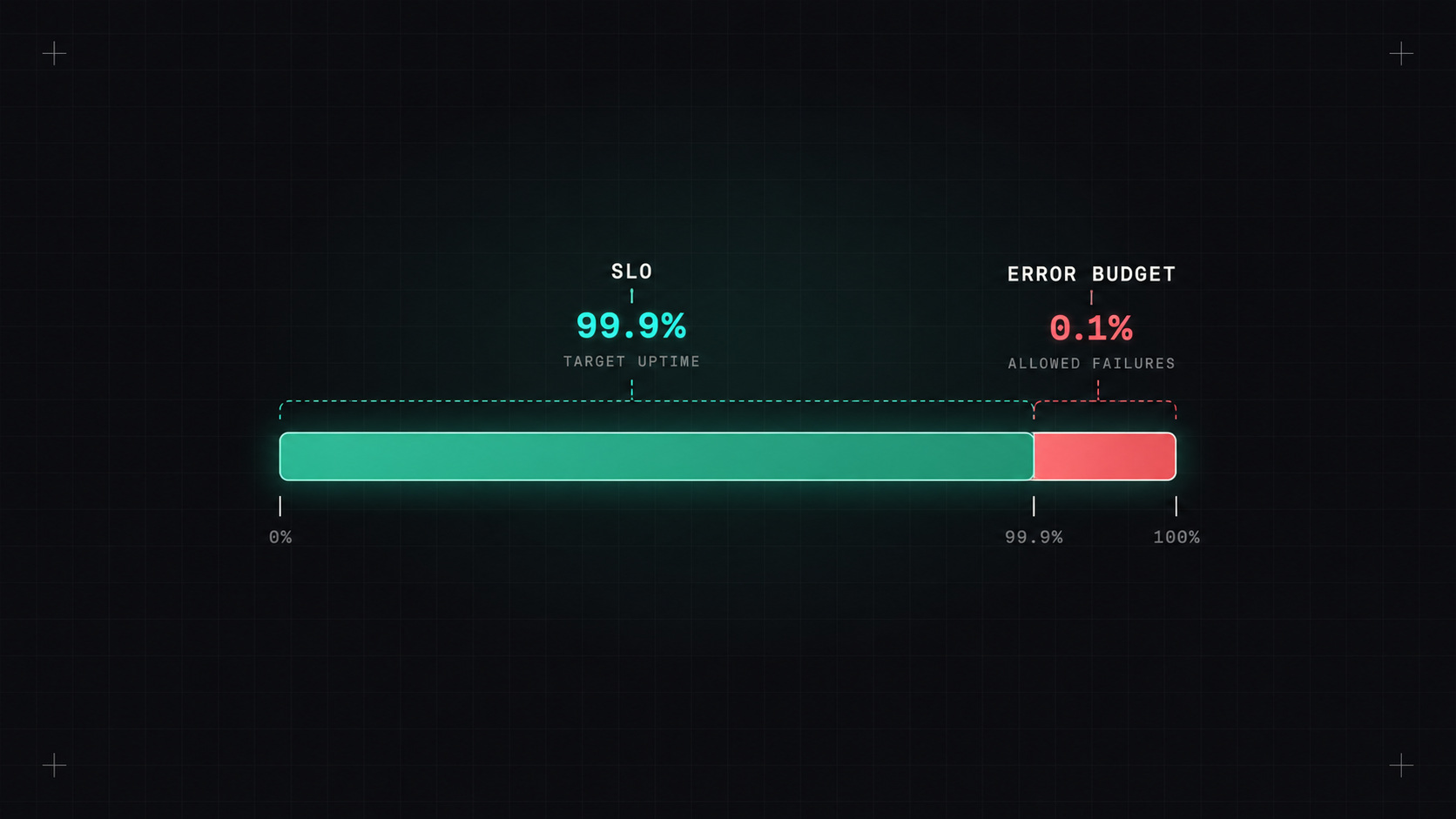
SLO (Service Level Objective): a target for that indicator over a time window. For example: 99.9% of requests succeed, measured over 30 days.
Error budget: the amount of failure the SLO allows. With a 99.9% target over 30 days, you can afford 0.1% failed requests, or roughly 43 minutes of full downtime.
SLA (Service Level Agreement): a contract with customers, usually with financial consequences. SLAs should be looser than your internal SLOs, so you notice problems before you owe anyone money.
The error budget turns reliability from an argument into a shared number.
Product and engineering stop arguing about "should we work on reliability or features?" The budget answers it.
An SLO isn't a promise that nothing breaks. It's an agreement about how much breaking is acceptable, and what we'll do when we go over.
Good SLIs measure what users actually experience:
Measure as close to the user as possible: at the load balancer or gateway rather than deep inside the service. Avoid SLIs like "CPU below 80%": users don't care about CPU.
Some practical advice:
| SLO | Allowed downtime per 30 days |
|---|---|
| 99% | about 7 hours 12 minutes |
| 99.5% | about 3 hours 36 minutes |
| 99.9% | about 43 minutes |
| 99.95% | about 22 minutes |
| 99.99% | about 4 minutes |
Looking at this table usually ends the "100%" conversation quickly.
SLOs also make alerting much better. Instead of alerting on CPU or individual errors, alert on how fast you're burning the error budget.
The Google SRE Workbook recommends multi-window, multi-burn-rate alerts, for example: page if you've burned 2% of the monthly budget in the last hour (and the last five minutes confirm it's still happening). That catches real incidents quickly and ignores short blips.
Writing these Prometheus rules by hand is tedious and error-prone. Tools generate them from a simple SLO definition:
# Sloth example
version: "prometheus/v1"
service: "shop-api"
slos:
  - name: "requests-availability"
    objective: 99.9
    sli:
      events:
        error_query: sum(rate(http_requests_total{job="shop-api",code=~"5.."}[{{.window}}]))
        total_query: sum(rate(http_requests_total{job="shop-api"}[{{.window}}]))
    alerting:
      page_alert:
        labels:
          severity: critical
Pick your most important user-facing service. Define one availability SLI and one latency SLI. Set targets based on the last month's real data. Add burn-rate alerts, show the budget on a dashboard, and review it as a team every couple of weeks.
My take: perfection isn't the goal. Knowing exactly how imperfect you can afford to be, and acting on it, is.
— Desly