Less to think about: reducing cognitive load for developers
Every YAML file you ask a developer to understand has a cost. How to make it smaller.
Every YAML file you ask a developer to understand has a cost. How to make it smaller.
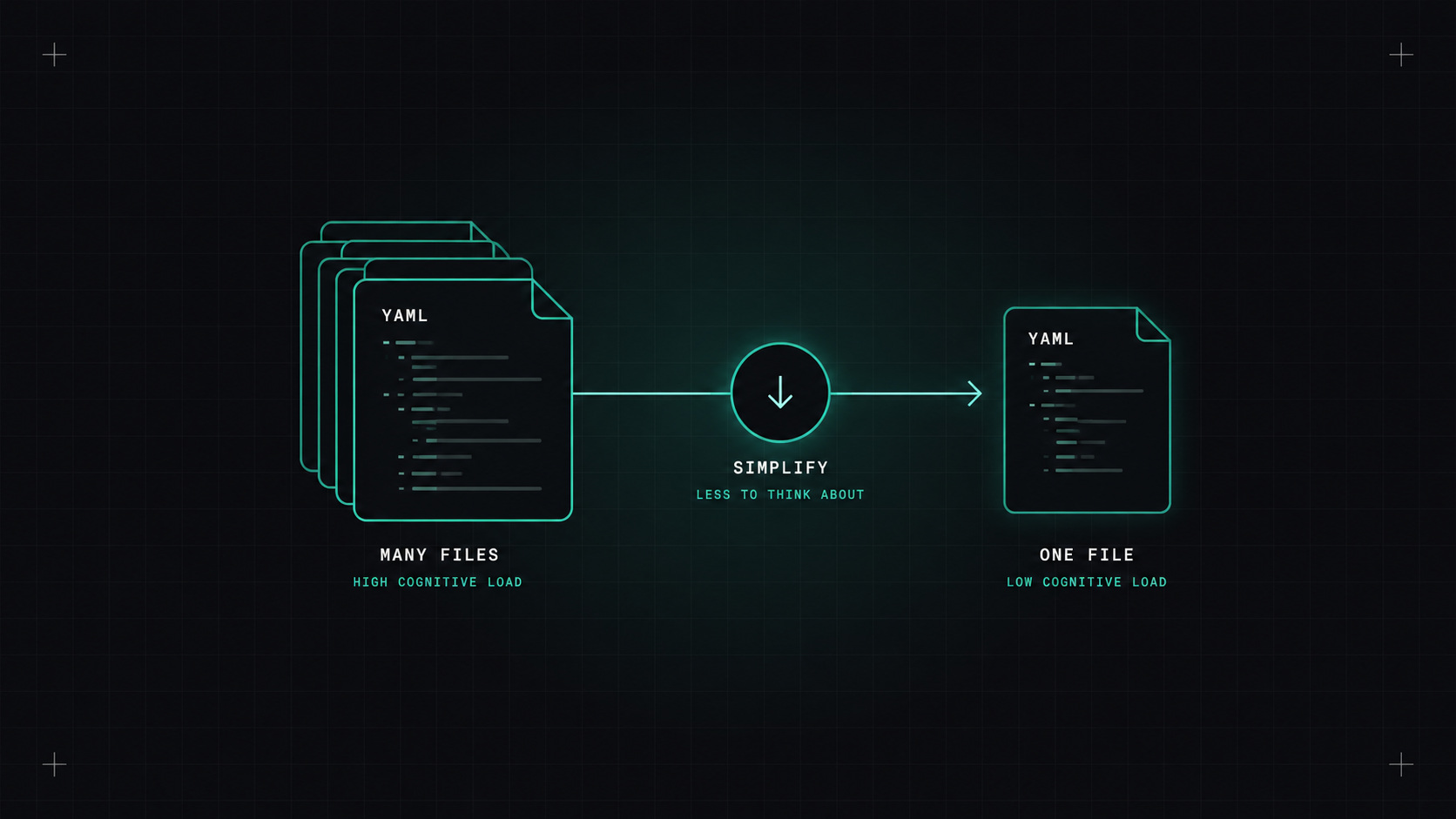
"You build it, you run it." I believe in that idea. Teams that own their services in production build better software. But somewhere along the way, "you run it" turned into "you need to understand Kubernetes, Helm, Terraform, IAM, networking, observability, security scanning and three CI systems". That's a lot to carry on top of actually building the product.
That weight has a name: cognitive load.
The idea comes from psychology, and the book Team Topologies made it popular in software. Every person and team has limited mental capacity. If too much of it is used on things that aren't their main job, their main job suffers.
There are roughly three kinds:
A platform team's job is to remove as much extraneous load as possible, so developers can spend their energy on the intrinsic and germane kinds.
If your developers need to understand your whole infrastructure to change one line of code, the infrastructure is the problem.
Kubernetes is a perfect example. It's powerful, but a simple web service needs a Deployment, a Service, an HTTPRoute or Ingress, a ConfigMap, maybe a HorizontalPodAutoscaler, a PodDisruptionBudget, a ServiceAccount, NetworkPolicies... Most developers don't need to know all of that.
Ways to reduce it:
App resource.The word "gently" matters. Don't hide Kubernetes so completely that debugging becomes impossible. Make the simple path simple, and keep the details available for people who need them.
Every decision you ask a developer to make is a small piece of load. Most of them have a sensible answer that's right 90% of the time.
Bake those answers into the platform:
Documentation still matters, but the best documentation is the one nobody has to read because the default is already right.
Platform teams can increase cognitive load too. Watch out for:
Ask developers regularly what slows them down. If the platform appears on that list, take it seriously.
Pick one area where developers struggle the most, often deployment configuration or observability. Reduce the number of things they need to know there. Measure whether questions to the ops team go down. Repeat.
My take: the best platform is the one developers barely notice. They just ship, and things work.
— Desly