When things break: incidents and blameless postmortems
The roles, the messages and the postmortem template I use.
The roles, the messages and the postmortem template I use.
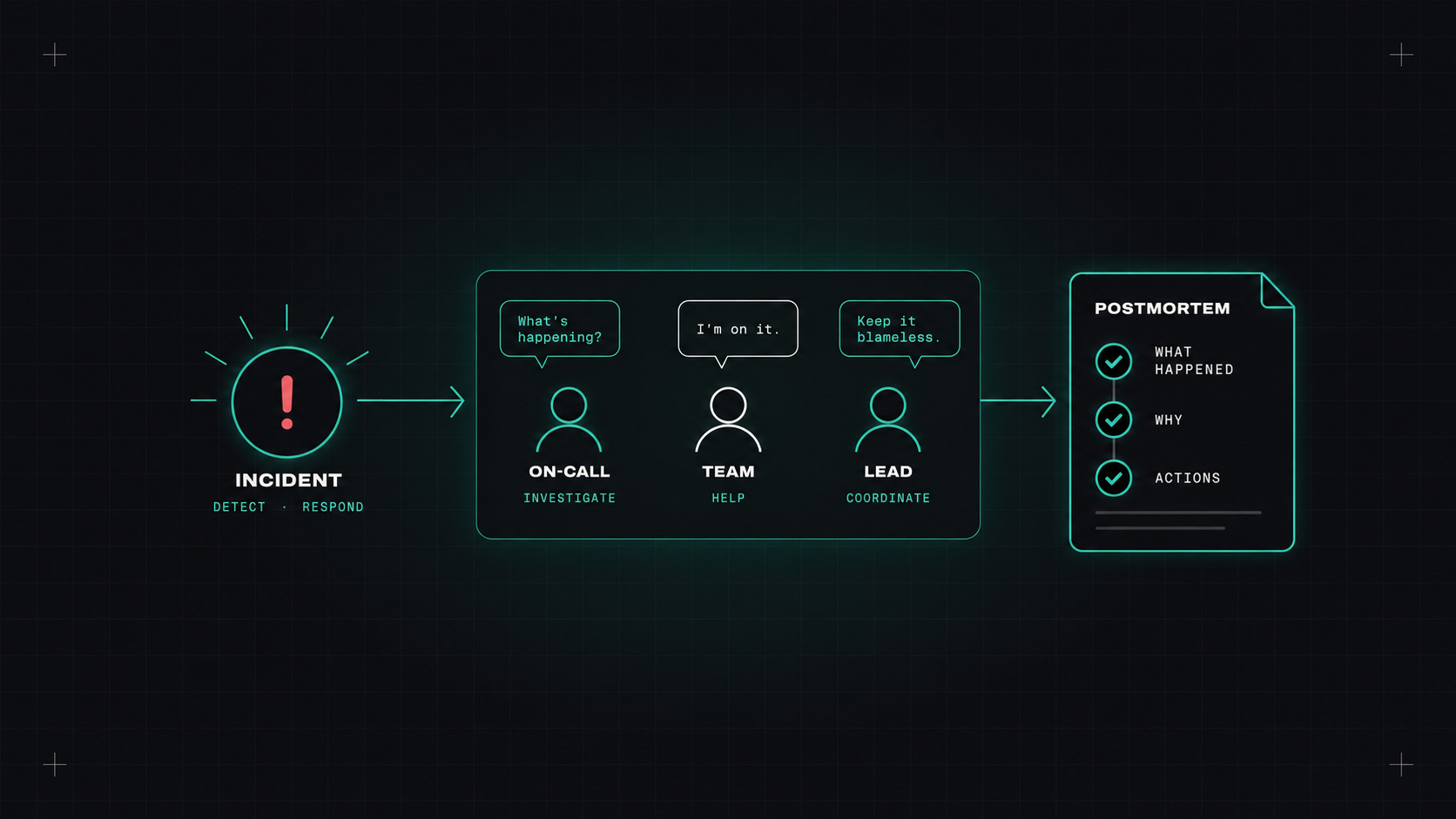
Every system breaks eventually. What separates good teams from struggling ones isn't whether they have incidents. It's how they handle them: calmly or chaotically, and whether they learn something afterwards or just move on and wait for the next one.
Here's the incident process I prefer, and how to write postmortems that actually improve things.
Incidents are stressful. Stress makes people bad at improvising. So decide the basics in advance:
A simple severity scale:
| Severity | Meaning | Example |
|---|---|---|
| SEV1 | Major impact on many users or core business | Checkout down for everyone |
| SEV2 | Significant impact, workaround exists or partial outage | Payments failing for one provider |
| SEV3 | Minor impact, limited users | A non-critical feature broken |
When in doubt, declare higher. It's easy to downgrade.
The most important role is the Incident Commander (IC). The IC doesn't fix the problem. They coordinate: make sure the right people are involved, decisions are made, and nothing falls through the cracks.
Other common roles:
In a small team, one person might take on multiple roles. That's fine, as long as someone is clearly in charge.
In an incident, the most dangerous situation is five smart people all fixing things at once, without anyone knowing what the others changed.
A few habits that make a big difference:
A simple status update template:
[SEV2] Payment failures, investigating. Since 14:05 CET, around 10% of card payments fail. Other payment methods work. We're investigating a possible issue with our payment provider. Next update by 14:45.
A postmortem is a written analysis of what happened and how to prevent it. Blameless means the focus is on the system, not on who made a mistake.
Why blameless? Because people make mistakes all the time, and systems should be designed to handle that. If the takeaway from an incident is "Alex should have been more careful", nothing changes, except that people start hiding mistakes. If the takeaway is "our deploy process let an untested config reach production without a check", you can fix the process.
Questions to ask:
The most common failure of postmortems: great analysis, a list of action items, and then nothing happens. Fixes compete with feature work and lose.
What helps:
incident.io, Rootly, FireHydrant, PagerDuty, Jira Service Management and others automate the process: creating channels, assigning roles, keeping timelines, posting status updates and generating postmortem drafts. Useful, but the process and culture matter more than the tool.
Agree on three severity levels, the incident commander role, and a postmortem template. Run a short practice incident (a "game day") so people know the process before a real one. Then, after the next real incident, write a blameless postmortem and follow through on its actions.
My take: incidents will happen. Handle them calmly, learn from them honestly, and fix the system instead of blaming the person.
— Desly