From sysadmin to DevOps
What carries over, what's missing, and how to make the move.
What carries over, what's missing, and how to make the move.
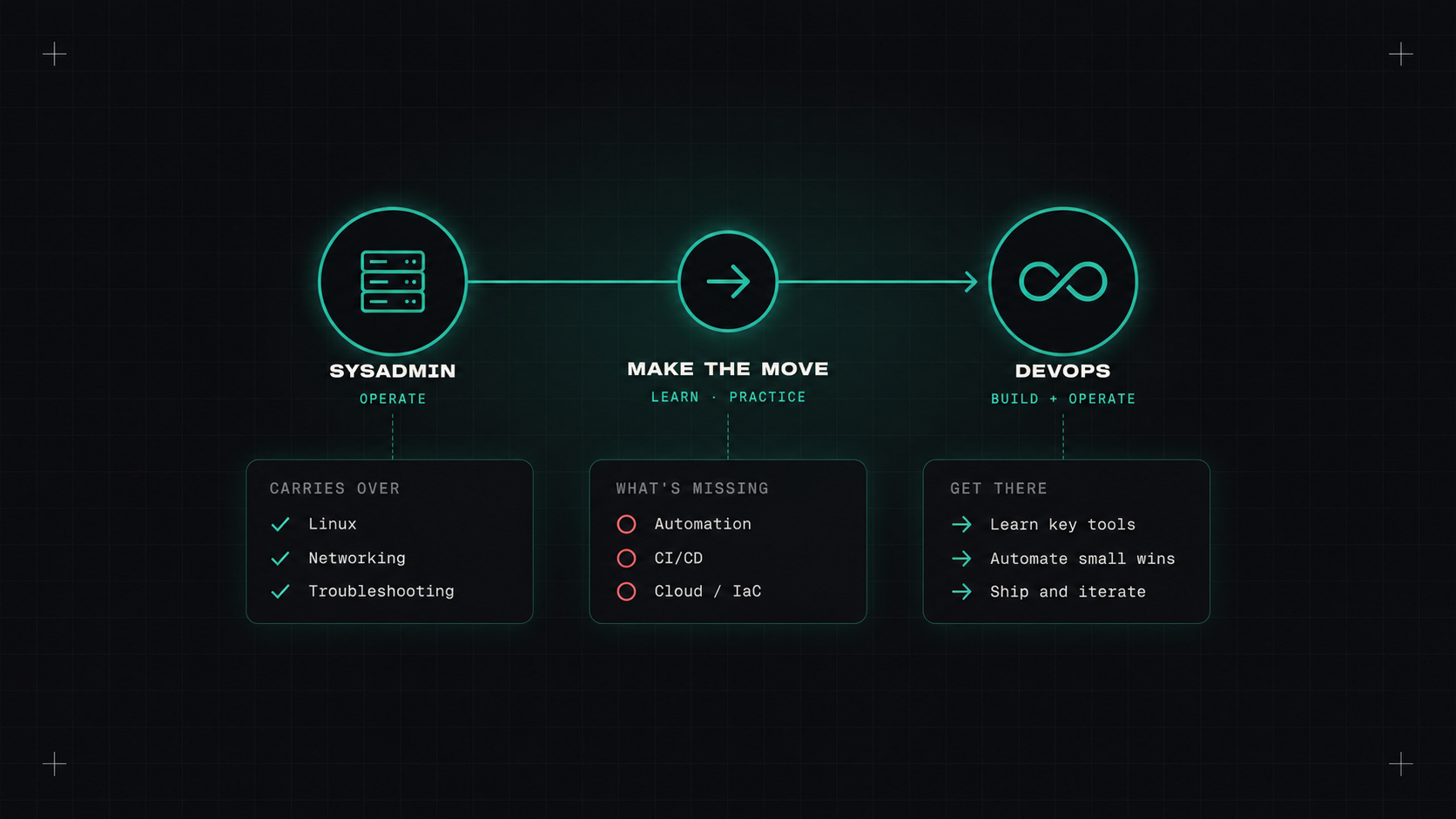
Many of the best DevOps engineers I know started as system administrators. They spent years keeping servers alive, fixing networks, restoring backups at 2 a.m., and being the person everyone called when "the internet is broken".
If that's you, and you're wondering whether you can move into DevOps: yes. You already have a big part of what it takes. You just need to change how you work, and add a few skills.
Sysadmins often underestimate how valuable their experience is. You probably already know:
These are exactly the skills that are hardest to teach and that interviewers look for in troubleshooting questions.
The shift from sysadmin to DevOps is mostly a shift in mindset: from doing things by hand to writing code that does things, and from pets to cattle.
The typical gaps:
1. Coding. Not just scripts, but code that's version-controlled, reviewed, tested and maintained. Python is the easiest start. Bash is useful but not enough.
2. Git and pull requests. Everything lives in Git: infrastructure, configuration, pipelines. Working through pull requests and code review becomes daily life.
3. Infrastructure as code. Terraform or OpenTofu instead of clicking or SSH-ing. Ansible for configuration.
4. Containers and Kubernetes. Packaging applications as containers, and running them on an orchestrator instead of on hand-managed servers.
5. CI/CD. Automated pipelines that build, test and deploy.
6. Cloud. If your background is on-premises, one major cloud provider. The good news: your networking and systems knowledge transfers very well, because the cloud is "just" someone else's data centre with an API.
7. Working closely with developers. Understanding how software is built, and helping teams ship, rather than receiving finished software to run.
The biggest change isn't the tools. It's moving from "I'll fix it" to "I'll make sure it fixes itself, or can't break that way again".
You don't have to wait for a DevOps job title to start doing DevOps work. Some ideas:
Every one of these becomes a story for your CV and interviews: "I automated our server provisioning with Ansible and Terraform, cutting setup time from two days to an hour."
A homelab is especially powerful for sysadmins, because you already understand the hardware and networking side. Build a small Kubernetes cluster, run your own services on it with GitOps, and break it on purpose.
Certifications can help signal the transition: CKA and a cloud associate certification are the most valuable. Linux certs like RHCSA are good, but you may already have the knowledge.
When updating your CV for DevOps roles:
Job titles to look for besides "DevOps Engineer": Site Reliability Engineer, Platform Engineer, Cloud Engineer, Infrastructure Engineer. Cloud engineer roles are often the easiest bridge from sysadmin work.
Absolutely. You already have the foundations many people coming from development lack. Add coding, Git, infrastructure as code and containers, start using them in your current job, and the title will follow.
My take: sysadmins don't need to start over to become DevOps engineers. They need to start writing down, in code, everything they already know how to do.
— Desly