Five Easy Pieces — Jack Nicholson's brooding stillness
The film's emotional core lies in its reluctance to offer easy resolutions. The tension between Bobby’s past and present remains unresolved but deeply felt.
The film's emotional core lies in its reluctance to offer easy resolutions. The tension between Bobby’s past and present remains unresolved but deeply felt.
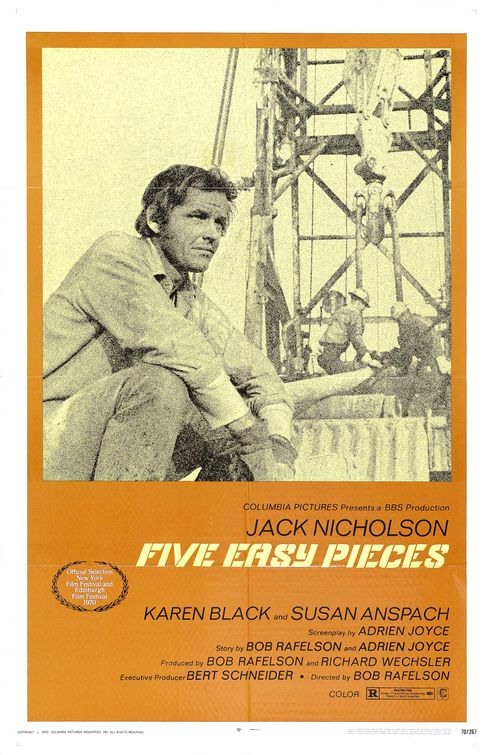
Spoiler-free review.
Jack Nicholson carries the film with a presence that feels both detached and deeply wounded, anchoring the story in quiet frustration. Bobby Dupea is a man caught between his working-class reality and an unfulfilled artistic potential, a conflict that drives much of the drama without needing exposition. The script avoids melodrama by focusing on small, awkward interactions that reveal the character’s inner turmoil.
The direction keeps scenes grounded in real-time tension, avoiding theatrical flourishes that might soften the character's edges. The pacing is deliberately slow, mirroring Bobby’s reluctance to confront his past or his identity. This approach might feel slow for some, but it lets the emotional stakes build gradually rather than being forced by plot mechanics.
Karen Black and Susan Anspach provide sharp contrast to Nicholson's stoicism, their dialogue often laced with biting honesty. Their performances highlight Bobby’s isolation without ever reducing him to a passive figure in their stories. The film’s weakness is that it doesn’t fully explore the emotional fallout of Bobby’s decisions, leaving some threads dangling without resolution.
This ambiguity may frustrate viewers expecting catharsis but aligns with the character's own indecision and emotional paralysis. The restraint in direction and dialogue gives the film a raw authenticity that feels more real than polished. Despite its flaws, the film remains a compelling study of identity and disconnection, anchored by Nicholson’s powerful, understated performance.
1970 · English. Film details · Poster source · Artwork © its respective rights holders.
The film's emotional core lies in its reluctance to offer easy resolutions. The tension between Bobby’s past and present remains unresolved but deeply felt.
— Desly