Why tools alone don't make DevOps
You can buy every tool and still have silos. Culture is the hard part.
You can buy every tool and still have silos. Culture is the hard part.
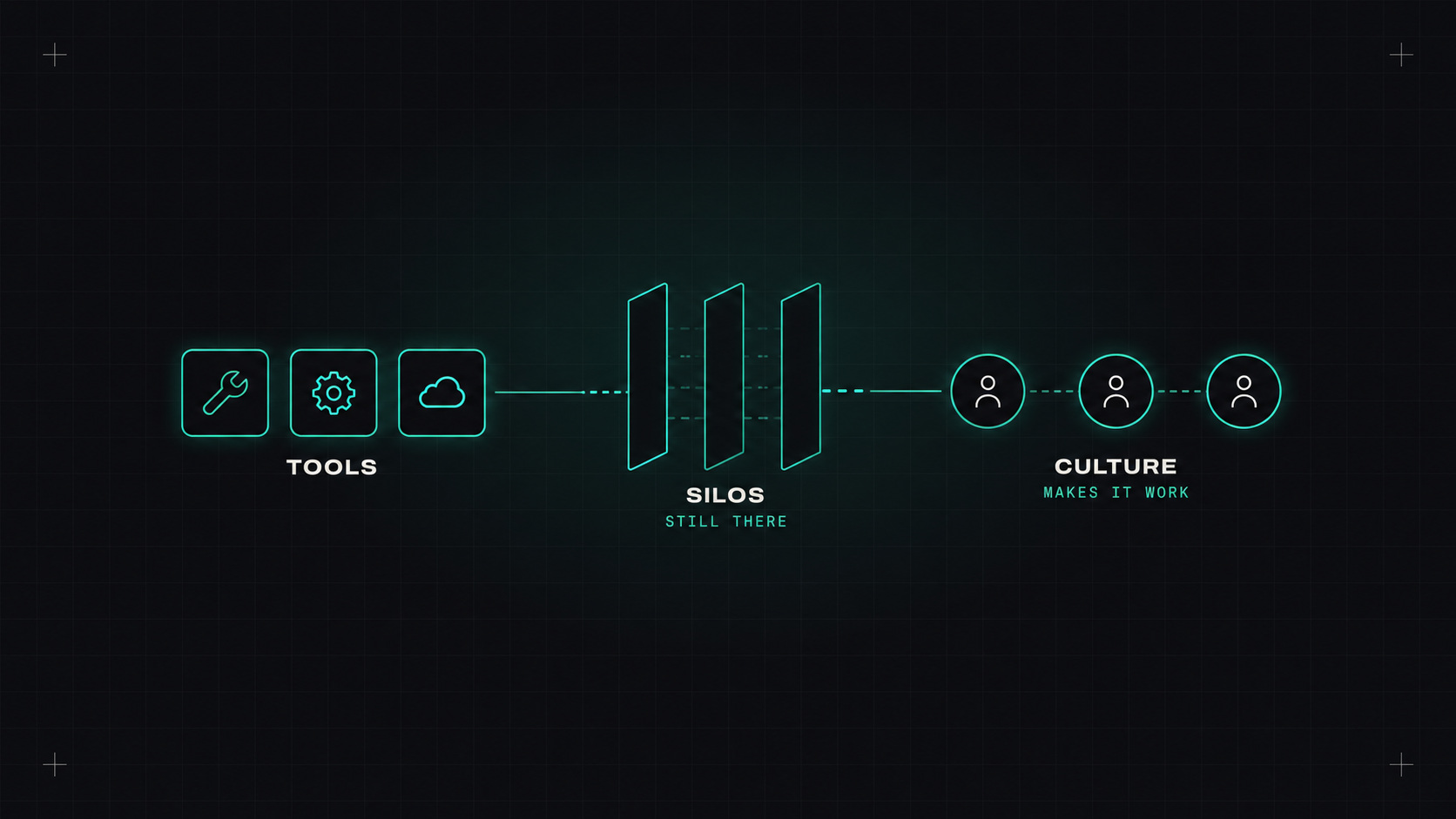
I've seen companies "do DevOps" by buying tools. Kubernetes, a CI/CD platform, an observability suite, maybe a new team called "DevOps". A year later, releases are still slow and painful, developers still throw code over the wall, and the new DevOps team is just the old ops team with a new name and a longer ticket queue.
The tools aren't the problem. They're just not the point.
The word "DevOps" was coined around 2009, when Patrick Debois organised the first DevOpsDays in Belgium. The problem it addressed was a human one: developers wanted to ship changes quickly, operations wanted stability. They had different goals, different managers and different incentives. So they fought, and software delivery was slow and fragile.
DevOps proposed bringing them together: shared goals, shared responsibility, shared tools, and a lot of automation so that speed and stability stop being opposites.
Notice the order. People and goals first, tools to support them.
A useful way to think about DevOps is CALMS, a framework popularised by Jez Humble and others:
Tools mostly cover the A and part of the M. The C, L, and S depend on how people work together.
Tools make good collaboration faster. They also make bad collaboration faster.
What actually helps:
Google's research on team effectiveness, known as Project Aristotle, found that the most important factor in high-performing teams was psychological safety: the belief that you won't be punished for speaking up, asking questions, or admitting mistakes.
The DORA research says something similar: a generative culture, where information flows freely and failure leads to inquiry rather than blame, predicts better software delivery and better well-being.
In practice, psychological safety in DevOps looks like:
Without it, problems get hidden, and hidden problems become outages.
If you want to move your organisation towards real DevOps:
Not at all. Good tools make good practices possible and scalable. But they come after the decision to work together differently, not instead of it.
My take: DevOps is something you practise, not something you buy. The tools are the easy part. The people are the point.
— Desly