Argo CD or Flux?
Both do GitOps well. The differences that matter when you pick one.
Both do GitOps well. The differences that matter when you pick one.
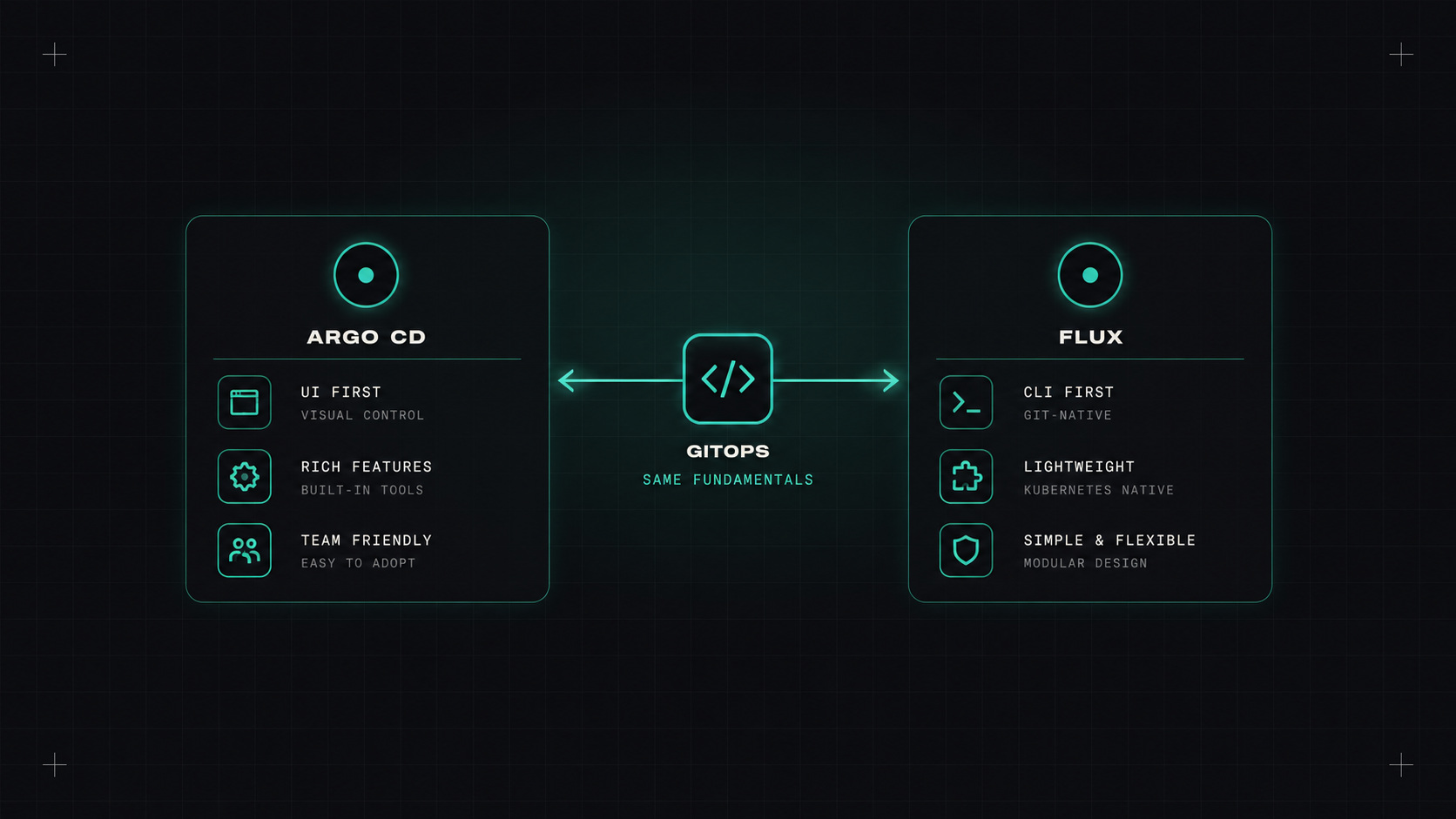
If you run Kubernetes and deploy with GitOps, you've almost certainly met this question. Argo CD and Flux are both graduated CNCF projects, both mature, both used by thousands of companies. Both will deploy your apps from Git reliably.
It's not about which one is better. It's about which one matches how your team works.
GitOps means Git is the source of truth for what runs in your cluster. Instead of a pipeline pushing changes with kubectl apply, an agent inside the cluster pulls the desired state from Git and continuously makes the cluster match it. Every change is a commit. Every rollback is a revert. Drift gets corrected automatically. The OpenGitOps project sums it up in four principles: declarative, versioned and immutable, pulled automatically, continuously reconciled.
Argo CD is an application-centric GitOps tool with a strong web UI.
Application points at a Git path and a target cluster. ApplicationSets generate many Applications from templates: one per cluster, per environment, per pull request.Flux is a collection of Kubernetes controllers that work like native Kubernetes components.
GitRepository, OCIRepository, Kustomization, HelmRelease. You manage Flux the same way you manage everything else.kubectl and the flux CLI.Argo CD shows you GitOps. Flux disappears into Kubernetes. Both are valid ways to love it.
| Argo CD | Flux | |
|---|---|---|
| Interface | Rich web UI plus CLI | CLI and CRDs, UI optional |
| Typical model | Central instance, many clusters | Agent per cluster |
| Multi-tenancy | Projects, RBAC, SSO in the UI | Kubernetes RBAC and namespaces |
| Helm | Renders charts into manifests | Native Helm releases via controller |
| Learning curve | Easy to start, UI helps | Very Kubernetes-native, steeper for beginners |
| Best fit | Teams wanting visibility and self-service | Platform teams wanting composable automation |
Whichever tool you pick, repository structure matters more than the tool. A common layout:
platform-gitops/
  clusters/
    prod-eu/
    prod-us/
    staging/
  infrastructure/      # cert-manager, gateway, monitoring, policies
    base/
    overlays/
  apps/
    shop/
      base/
      overlays/
        staging/
        prod/
Some principles that help:
The tricky part of GitOps isn't deploying. It's promotion: moving a version from dev to staging to production in a controlled way. Updating a YAML file in three places by hand gets old quickly.
Options:
If your developers will interact with deployments directly and value seeing what's going on, Argo CD. If your platform team wants composable, Kubernetes-native building blocks and is happy with CLIs, Flux. If you can't decide: try both on a test cluster for a week. The one your team reaches for naturally is the right one.
My take: the best GitOps tool is the one your team actually understands. Pick one, structure your repos well, and the rest follows.
— Desly